CLICK TO ENLARGE
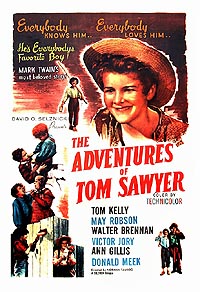
THEATER POSTER
c1950 RE-RELEASE OF
1938 SELZNICK FILM
|
Mark Twain's times included the birth of a
new medium, the movies. He lived long enough to have seen
the first film version of one of his books, the 1907 Tom
Sawyer. Given his fascination with new inventions, he
might have wanted to see this adaptation, but there is no
record of his having done so.
In the century since, Tom Sawyer has
been the most frequently filmed of MT's books. It was
filmed three times before Huck Finn was filmed at
all, and Tom himself was the star of the second movie
version of Huck's story (see below). The next
century might tell a different story. Based on my students' testimony, The Adventures of
Tom Sawyer is still read, but it seems safe to say that most Americans born since 1975 mainly
know Tom through Huck's novel, and know the plot of Tom Sawyer mostly through the more recent films
on the list below. In another generation it might be
time for Tom to say, "You don't know about me except
you have read a book by the name of 'Huckleberry
Finn.'"
Unlike the film versions of Huck's story, the
movies made from Tom's adventures stick pretty closely to
the plot of MT's original text. Even the most recent
version, for example, still identifies its villain as
"Injun Joe." No film attempts to incorporate the overt
nostalgia of the novel's backward-looking narrator, but all
treat both boyhood and the American past as
playgrounds.
|
|
Images Courtesy Dave Thomson
|

Like about 90% of the early silent movies, this
first film adaptation of The Adventures of Tom Sawyer
seems to be lost. The very brief entry on it in the Internet
Movie Data Base contains only two names, under "Writing
Credits" -- Gene Gauntier and Mark Twain.
|
|
CLICK IMAGES BELOW TO VIEW
ENLARGEMENTS
|
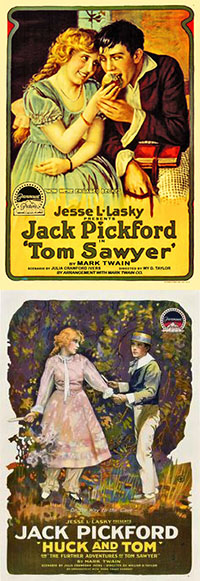
A decade later William Desmond Taylor directed two film adaptations of MT's novel, both produced by the Famous Players Picture Corporation and distributed by Paramount. Julia Crawford Ivers' script for Tom Sawyer (1917) derives mainly from chapters 1 - 6 and 13 - 17 of the text. Jack Pickford, Mary's younger brother, played Tom, Clara Horton played Becky, and Robert Gordon played Huck.
Tom Sawyer was followed up a year later by Huck and Tom, or The Further Adventures of Tom Sawyer (1918), also for Famous Players and Paramount and with the same cast. This time Ivers' script focused more on the episodes that feature the two boys -- from the murder in the graveyard through the discovery of the treasure -- but as you can see from the poster below left, it still emphasized Tom's relationship with Becky. (In 1920 Taylor directed a different cast in the Famous Players' production of Huckleberry Finn.)
For an autographed publicity photo of Gordon as Huck, CLICK HERE.The links below will open up several publicity stills from Tom Sawyer (left) and Huck and Tom (the other three):
GOING TO CHURCH
|
IN THE GRAVEYARD
DIGGING FOR TREASURE
RICH
|
 The first sound adaptation of MT's novel was
made in 1930 by Paramount, and featured Jackie Coogan (whom
Chaplin had made a star at age 7 in The Kid [1921]) as
Tom. Huck was played by Junior Durkin, Becky by Mitzi Green,
and Sid by Jackie Searl. Clara Blandick, who would be better
known for an Auntie named Em in The Wizard of Oz
(1939) played Aunt Polly. In the second still photo
below, Charlie Stevens is playing Joe and Tully Marshall is Muff Potter (the actor who played Dr. Robinson was uncredited):
The first sound adaptation of MT's novel was
made in 1930 by Paramount, and featured Jackie Coogan (whom
Chaplin had made a star at age 7 in The Kid [1921]) as
Tom. Huck was played by Junior Durkin, Becky by Mitzi Green,
and Sid by Jackie Searl. Clara Blandick, who would be better
known for an Auntie named Em in The Wizard of Oz
(1939) played Aunt Polly. In the second still photo
below, Charlie Stevens is playing Joe and Tully Marshall is Muff Potter (the actor who played Dr. Robinson was uncredited):
POLLY, TOM &
SID |
IN THE GRAVEYARD |
TOM SEES
JOE |
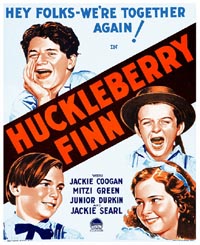
"I did wish Tom Sawyer was here," Huck says in
the novel he narrates. Early Hollywood seems to have been
felt the same way (at least when box-office star Jackie
Coogan played him). After Paramount's success with Tom
Sawyer in 1930, the studio hired Norman Taurog to direct
a new version of Huckleberry Finn. Released in 1931,
it again starred Jackie Coogan, Junior Durkin, Mitzi Green
and (again as Sid) Jackie Searl. That's them you see at
left. Despite Jim's absence from the poster, the film
does follow his and Huck's misadventures on the raft --
though as you can see from the following publicity stills,
Tom comes along with them for the ride:
ESCAPE FROM
PAP'S | ON THE
RAFT | WITH THE
KING & DUKE |
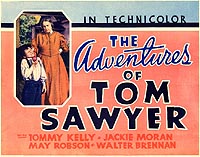 A year before he made Gone with the Wind, David O. Selznick
went back to ante bellum Missouri with his version of The
Adventures of Tom Sawyer (1938). Directed by Norman
Taurog, who had done Huck Finn for Paramount in 1931
and who also directed Boys Town with Mickey Rooney and
Spencer Tracy in 1938, the film starred Tommy Kelly as Tom,
Jackie Moran as Huck, Ann Gillis as Becky Thatcher, May
Robson as Aunt Polly, Philip Hurlic as "Little Jim" and gets
memorable performances from Walter Brennan as Muff Potter and
Victor Jory as Injun Joe.
A year before he made Gone with the Wind, David O. Selznick
went back to ante bellum Missouri with his version of The
Adventures of Tom Sawyer (1938). Directed by Norman
Taurog, who had done Huck Finn for Paramount in 1931
and who also directed Boys Town with Mickey Rooney and
Spencer Tracy in 1938, the film starred Tommy Kelly as Tom,
Jackie Moran as Huck, Ann Gillis as Becky Thatcher, May
Robson as Aunt Polly, Philip Hurlic as "Little Jim" and gets
memorable performances from Walter Brennan as Muff Potter and
Victor Jory as Injun Joe.
18 PUBLICITY PHOTOS | GROSSET & DUNLAP PHOTOPLAY EDITION |
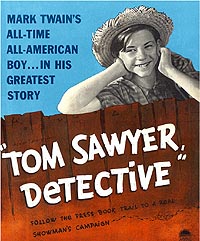
MT wrote Tom Sawyer, Detective along
with Tom Sawyer Abroad in the mid-1890s, two decades
after Tom's first novel appeared. At the time he was more
desperate for money than at any other point in his career,
and seems mainly to have been trying to cash in on the
established marketability of Tom's name. Presumbably Adolph
Zukor had much the same motive when he produced this film for
Paramount at the same time that Selznick was making his film.
The cover of the film's publicity book (left) shows a
young Donald O'Connor, who actually played Huck. Huck and Tom both appear in the two posters below.
ANOTHER POSTER | ANOTHER POSTER |
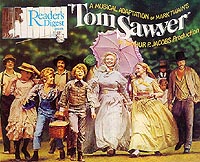
This 1973 musical adaption was Reader's
Digest's first venture into movie-making. It starred Johnny
Whitaker as Tom, Jeff East as Huck and Jodie Foster as Becky.
The score (by Richard Sherman, Robert Sherman and John
Williams) received both Oscar and Golden Globe nominations.
Reader's Digest used Jeff East again when it brought out a
musical version of Huckleberry Finn in 1974, though
Tom's character doesn't appear in this sequel. |
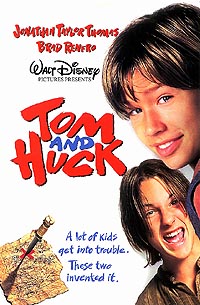 Jonathan Taylor Thomas was a 14-year-old TV
star when Walt Disney Pictures hired him to play Tom;
13-year-old Brad Renfro was making his third movie in a
year and a half. Disney released this 1995 movie under two
other names as well: The Adventures of Tom and Huck
and just plain Tom Sawyer, but it was best known by
the name Tom and Huck. On the one hand, that title
suggests how well known the pair was by the end of the last
century. On the other, since the movie's plot derives
exclusively from Tom's novel, not Huck's, the prominent use
of Huck's name suggests there may have been concern about
whether Tom's name by itself would draw enough attention
and customers to the film. In MT's novel, we learn that Tom
"did not care to have Huck's company in public places." Now
he seems to need it to keep his own place in the public's
mind. When Disney brought out The Adventures of Huck
Finn in 1993, Tom's character was left out
entirely.
Jonathan Taylor Thomas was a 14-year-old TV
star when Walt Disney Pictures hired him to play Tom;
13-year-old Brad Renfro was making his third movie in a
year and a half. Disney released this 1995 movie under two
other names as well: The Adventures of Tom and Huck
and just plain Tom Sawyer, but it was best known by
the name Tom and Huck. On the one hand, that title
suggests how well known the pair was by the end of the last
century. On the other, since the movie's plot derives
exclusively from Tom's novel, not Huck's, the prominent use
of Huck's name suggests there may have been concern about
whether Tom's name by itself would draw enough attention
and customers to the film. In MT's novel, we learn that Tom
"did not care to have Huck's company in public places." Now
he seems to need it to keep his own place in the public's
mind. When Disney brought out The Adventures of Huck
Finn in 1993, Tom's character was left out
entirely.
© The Walt Disney Company; all rights reserved.
|
)
)
)
)
)
)
)
)
)
)
)
)
)
)
)
)
)
)
)
)